How Earth's Magnetic Field Protects Life — and What Happens When It Weakens
Earth's magnetic field protects life from solar wind, enables animal navigation across thousands of kilometres, and its current weakening already affects satellites. Here's why it matters beyond atmospheric shielding.
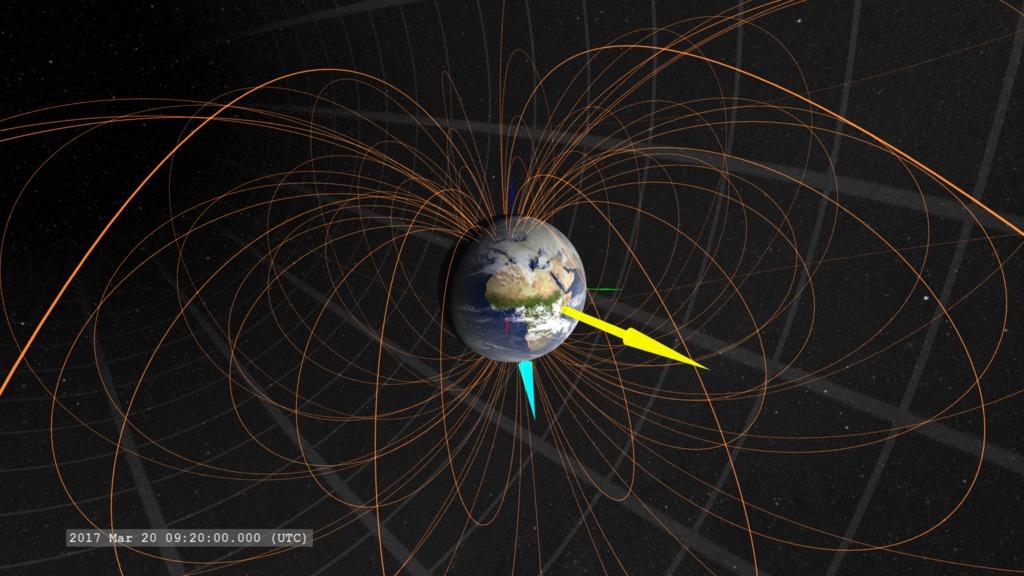
How Earth’s magnetic field protects life is a question with a surprisingly long answer. Strip away the atmosphere and you remove the air. Strip away the magnetic field and you begin removing the atmosphere too — and eventually the water, and every mechanism that makes surface life possible. The magnetosphere is not decorative. It is structural, and understanding its role clarifies why planetary magnetic fields are among the first things astrobiologists look for when assessing a world’s habitability.
A Shield 60,000 Kilometres Deep
The solar wind — a continuous stream of charged particles ejected from the Sun at 400 to 800 km/s — would, without deflection, strip volatiles from planetary atmospheres over geological timescales. Mars is the cautionary example: once apparently capable of supporting liquid water on its surface, it lost its global magnetic field roughly 4 billion years ago. The solar wind subsequently eroded most of its atmosphere, leaving a thin remnant 1% as dense as Earth’s at sea level.
Earth’s magnetosphere deflects the vast majority of this flux. On the sunward side, the solar wind compresses the magnetosphere to a standoff distance of roughly 10 Earth radii — approximately 60,000 km. On the night side, the magnetic field is stretched into a magnetotail extending hundreds of Earth radii downstream. The structure is not static: it breathes and distorts in response to variations in the solar wind, with the compressed dayside contracting during solar storms and the magnetotail releasing stored energy in substorm events that drive the auroras.
The Connection to Animal Navigation
One of the most biologically consequential properties of the magnetic field is that life has learned to read it. Magnetoreception — the ability to sense magnetic field direction and intensity — has been confirmed in at least ten major animal groups, including birds, fish, sea turtles, insects, and mammals.
The mechanism is not fully resolved for all species. In certain bacteria, organelles called magnetosomes contain chains of magnetite crystals that act as miniature compass needles, aligning the organism along field lines to navigate toward favoured sediment layers. In birds, two candidate mechanisms have been proposed: cryptochrome-based radical-pair reactions in the retina that may produce a magnetic-field-sensitive visual signal, and magnetite particles in the beak and inner ear that could transduce field strength mechanically.
Whatever the mechanism, the behavioural consequences are well-documented. Homing pigeons show directional disorientation when small magnets are attached to their heads. Sea turtles use both the inclination angle and intensity of the field as a bicoordinate map to navigate thousands of kilometres from foraging grounds to natal beaches. Arctic terns complete 70,000 km annual migrations, pole to pole, apparently guided in part by field geometry.
These adaptations have co-evolved with a field that, while generally stable over organismal timescales, has varied considerably over geological time.
Magnetic Reversals: When the Field Flips
Geomagnetic reversals — events in which the north and south magnetic poles exchange positions — have occurred hundreds of times in Earth’s history, with typical intervals of hundreds of thousands of years. The last reversal, the Brunhes-Matuyama boundary, occurred approximately 780,000 years ago.
During a reversal, the field does not simply flip instantaneously. The transition takes thousands of years, passing through a period of significantly reduced and highly irregular field geometry — with multiple poles, rapidly shifting positions, and greatly reduced overall intensity. Total field strength during these transitions may drop to 10–20% of its interreversal value.
The consequences are debated. Some palaeomagnetic records correlate reversals with elevated extinction rates or species turnover, though establishing causality is difficult. What is clear is that reduced field intensity would increase surface UV and cosmic ray flux, potentially sufficient to damage DNA in organisms not protected by thick atmospheric or aquatic shielding.
The current field, which has been weakening at approximately 5% per century since measurements began in the 1840s, is not necessarily headed for imminent reversal. Field strength fluctuations of this magnitude have occurred before without triggering a full polarity reversal. But the South Atlantic Anomaly — where field intensity is already 30% below global average and the anomaly continues to expand — is a contemporary demonstration of what partial field weakness looks like.
What This Means for Space Exploration
For human exploration beyond Earth’s magnetospheric protection, the field’s absence is not an abstract concern. Astronauts in cislunar space and on the lunar surface are exposed to the full spectrum of galactic cosmic rays and solar energetic particles with no magnetospheric deflection and minimal atmospheric shielding.
The radiation dose accumulated during a six-month transit to Mars, plus a surface stay, plus the return journey would likely exceed the career radiation limits currently applied to astronauts in LEO — potentially by a factor of two or three, depending on solar cycle phase. Solving this is one of the genuinely hard engineering problems of deep space human exploration, and the Earth’s magnetic field is the benchmark against which every proposed shielding solution is measured.
The Quiet Foundation
The magnetic field rarely features in popular accounts of what makes Earth habitable. The atmosphere gets the attention, the liquid water, the distance from the Sun. But the magnetosphere is the system that has preserved the atmosphere over 4 billion years, protected surface biochemistry from the worst of solar and cosmic radiation, and quietly enabled the navigational sophistication of hundreds of animal species.
It is also, by planetary standards, something of an anomaly. Of the rocky planets in our solar system, only Earth maintains a strong, persistent global magnetic field today. Venus does not. Mars does not. Mercury has a weak one. The reasons are tied to internal heat flow, core composition, and rotation rate — parameters that are still being mapped as we characterise more terrestrial exoplanets.
When we eventually find a potentially habitable world around another star, among the first questions will be: does it have a magnetic field? Earth’s own field tells us exactly why that question matters. For a closer look at the most operationally significant consequence of the field’s current weakening over the South Atlantic, see why satellites malfunction over the South Atlantic Anomaly.