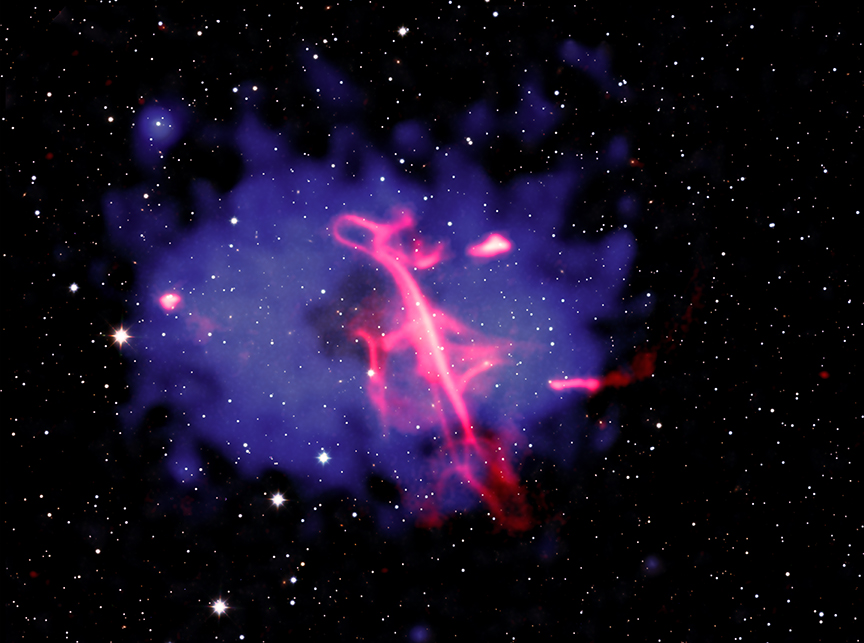
A radio structure 1.55 billion light-years away traces a musical symbol. Chandra, eROSITA and LOFAR data now explain why, revealing a hidden galaxy cluster merger.
X-ray: NASA/CXC/INAF-IRA/A. Botteon et al.; Infrared: UKIDSS-GPS; Radio: ASTRON/LOFAR; Image processing: NASA/CXC/SAO/N. Wolk
A radio structure cataloged as VLSS J0318.9+5755 traces the outline of a treble clef, the musical symbol, with enough fidelity that the resemblance is not a stretch of imagination. The object sits 1.55 billion light-years away, at redshift z=0.117, and spans roughly 760 kiloparsecs, about 2.5 million light-years end to end. A team led by Andrea Botteon of Italy’s National Institute for Astrophysics (INAF) has now explained how it formed, combining NASA’s Chandra X-ray Observatory with Germany’s eROSITA, the GMRT, LOFAR, and the UKIRT infrared telescope. The paper appeared in Astronomy & Astrophysics.
The explanation is a two-stage history written in plasma. A supermassive black hole at the center of a galaxy cluster went through an active phase, launching particles and magnetic fields at close to the speed of light. That jet activity produced the original radio glow. It faded over time, as aging plasma always does. Then the cluster collided with a second one, and the merger’s shockwaves compressed and reenergized the old plasma, lighting it back up in radio waves. Astronomers call this object class a radio phoenix.
What makes VLSS J0318.9+5755 hard to find is not its physics. It is its address. The structure sits almost exactly behind the plane of the Milky Way, in a region astronomers call the Zone of Avoidance, where our own galaxy’s dust and gas block roughly 20% of the extragalactic sky from view at optical and even some radio wavelengths. It took five instruments working across the electromagnetic spectrum to see through that obscuration and confirm what was hiding there.
A Discovery Buried in Survey Data
The Treble Clef was not found by a targeted search. It surfaced while Botteon’s team combed through the LOFAR Two-metre Sky Survey (LoTSS), a radio mapping project built on the LOw Frequency ARray, a pan-European network of radio antennas operated by ASTRON. LoTSS was designed to map the low-frequency radio sky at a depth and resolution no previous survey had achieved, and one side effect of that depth is turning up objects too faint, too obscured, or too strange to have been cataloged before.
The Zone of Avoidance has historically been a blind spot for extragalactic astronomy precisely because optical surveys, which built most of the galaxy cluster catalogs in use today, cannot see through the Milky Way’s disk. Low-frequency radio and X-ray observations suffer far less absorption from galactic dust, which is why a radio and X-ray combination, rather than an optical one, was the tool that finally resolved this object. Confirmation followed with the Giant Metrewave Radio Telescope (GMRT) in India, adding higher-resolution radio data, and with LOFAR’s own low-band antennas (LoLSS) extending the frequency coverage further.
The Physics of a Revived Radio Source
A radio phoenix is distinguished from an active radio jet by its spectrum. Freshly accelerated particles from an active black hole produce a relatively flat radio spectrum, radio brightness that declines gently with increasing frequency. Aged, previously-faded plasma that gets a second kick from a cluster merger shockwave produces something far steeper. The Treble Clef’s spectral index exceeds α > 4 between 400 and 650 MHz, an extremely steep decline that is itself evidence the electrons being observed are old and were reenergized rather than freshly injected.
That steep spectrum is the fingerprint the team used to classify the object as a radio phoenix rather than an active radio galaxy or a merger-driven radio halo, the other common sources of diffuse cluster-scale radio emission. The distinction matters because each of these classes traces a different chapter of a cluster’s history: an active radio galaxy marks an ongoing black hole outburst, a halo marks turbulence from an in-progress merger, and a phoenix marks the resurrection of a much older outburst by a later, unrelated merger event.
What Chandra Added to the Picture
The radio data alone could explain the shape. It could not confirm that a galaxy cluster, let alone a merging one, actually sat at that location. That confirmation came from X-rays. Chandra observed the field across four separate pointings in April 2026, using its ACIS imaging detector for a combined 13 hours and 34 minutes of exposure (observation IDs 30487 and 32286 through 32288). Combined with all-sky data from eROSITA, the X-ray observations revealed diffuse, multimillion-degree gas, intracluster medium with a temperature of kT = 6.4 ± 0.6 keV, equivalent to about 74 million kelvin, exactly where the radio structure sits.
That hot gas is the direct signature of a galaxy cluster’s gravitational potential well. Its presence confirmed the Treble Clef is not an isolated radio curiosity but the radio-wavelength signature of a genuine, massive cluster, with mass estimated at M500 ≈ 5.4 to 6.0 x 10^14 solar masses depending on whether the luminosity-based or temperature-based scaling relation is used. The X-ray morphology further showed the gas is not relaxed into a single smooth clump. It is elongated along an east-west axis, consistent with two subclusters that collided and are now separating after passing through each other, likely within the last few hundred million years. The revived plasma’s radiative age, how long it has been glowing since reacceleration, works out to roughly 190 to 200 million years, placing the merger and the phoenix’s rebirth on a compatible timeline.
Seeing Through the Galaxy
No single instrument in this study could have closed the case alone. LOFAR’s low frequencies and GMRT’s higher resolution mapped the radio morphology and spectrum. Chandra and eROSITA’s X-rays confirmed the hot intracluster medium and measured its temperature and mass. UKIRT’s near-infrared data, from the UKIDSS Galactic Plane Survey, helped characterize the foreground stellar density along this heavily obscured line of sight, information the team needed to separate genuine cluster emission from contamination by Milky Way sources sitting in the same patch of sky.
This is the practical argument for multiwavelength astronomy applied to the Zone of Avoidance specifically: each wavelength regime is blocked by a different combination of absorption and confusion, and stacking instruments that are blind to different obstacles is currently the only way to map what optical surveys cannot reach.
Why a Hidden Cluster Matters
Galaxy cluster catalogs feed directly into cosmological work, from mapping the large-scale structure of the universe to calibrating cluster mass functions used in dark energy studies. A systematic gap in cluster detection along roughly a fifth of the sky is not a cosmetic problem. It is a census gap. Radio and X-ray surveys of the Zone of Avoidance, of which this discovery is one data point, are a direct attempt to close it, and LoTSS’s continuing coverage means more objects like VLSS J0318.9+5755 are likely still sitting in the data, waiting for someone to notice a shape that does not belong.
What else is hiding behind our own galaxy, waiting for the right combination of instruments to be caught looking?