Lagrange Points: Where JWST Lives and Why L4/L5 Are Crowded
Lagrange points are positions where a small body can orbit in sync with two larger masses. Why L1, L2, and L3 are unstable but useful, why L4 and L5 are stable and ancient, and what JWST's halo orbit at L2 costs to maintain.
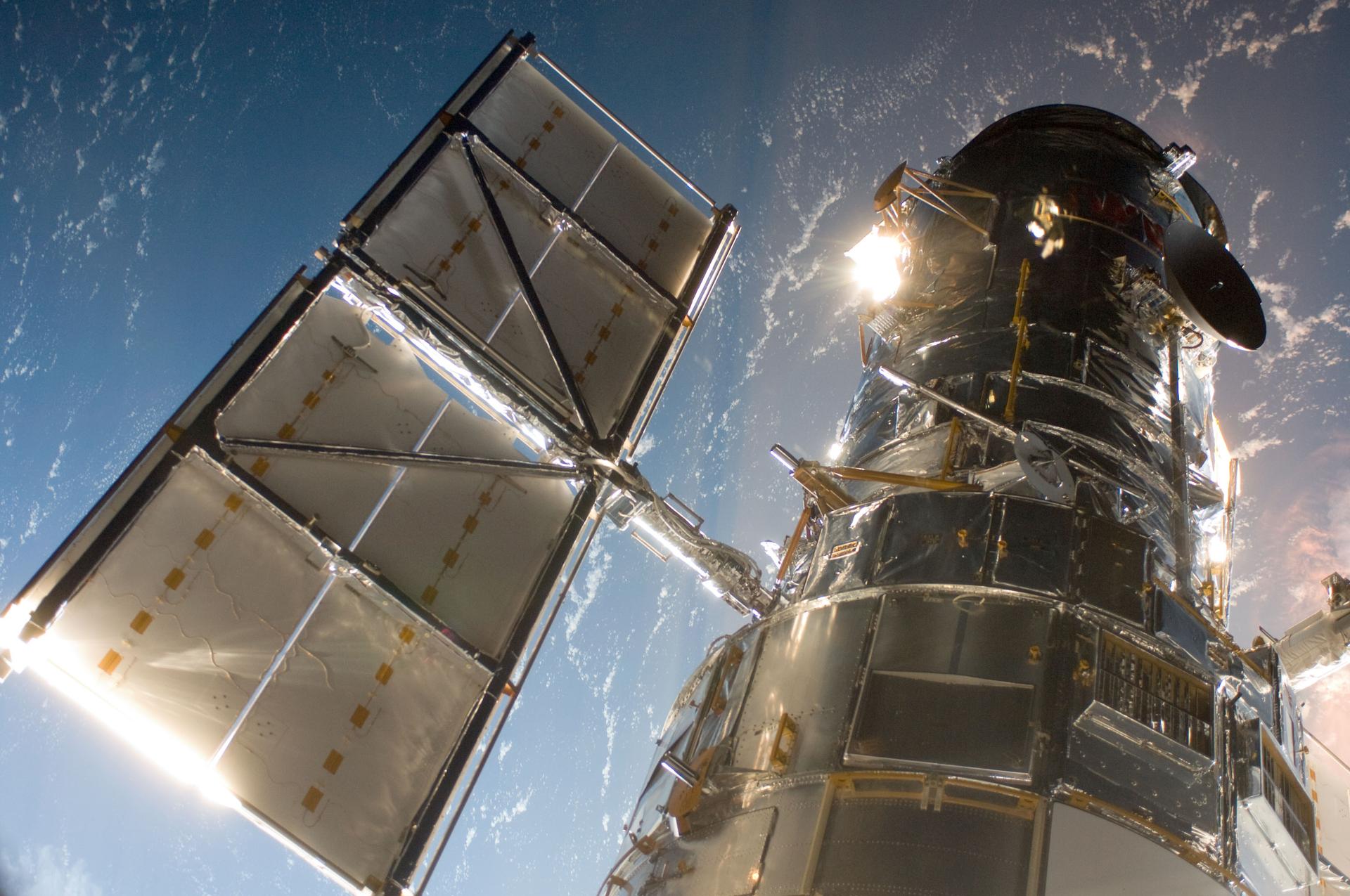
At five specific locations in any two-body gravitational system, a third body of negligible mass can remain stationary relative to the two larger bodies. These are the Lagrange points — named for the Franco-Italian mathematician Joseph-Louis Lagrange, who identified them analytically in 1772. They are not physically special locations in space; they are mathematical consequences of the balance between gravitational attraction and the centrifugal force in the rotating reference frame of the two-body system.
Three of the five Lagrange points are unstable equilibria — a spacecraft placed exactly at L1, L2, or L3 will eventually drift away without station-keeping. The other two, L4 and L5, are stable: a body displaced from them returns, and over billions of years they have accumulated clouds of natural objects called Trojans. The distinction between stable and unstable, and the practical uses of both classes, is what makes Lagrange point mission design one of the most elegant applications of celestial mechanics.
Key parameters
| Point | Location | Stability | Sun-Earth distance | Examples |
|---|---|---|---|---|
| L1 | Between Sun and Earth | Unstable | ~1.5 million km (sunward) | SOHO, DSCOVR, ACE |
| L2 | Beyond Earth (anti-sun) | Unstable | ~1.5 million km | JWST, Gaia, Planck, Herschel |
| L3 | Opposite Earth on orbit | Unstable | ~1 AU (far side of Sun) | No current missions |
| L4 | 60° ahead of Earth | Stable | ~1 AU | Earth Trojans (2010 TK7) |
| L5 | 60° behind Earth | Stable | ~1 AU | Proposed space colonies |
The Mathematics of Lagrange Points
In the circular restricted three-body problem — two massive bodies (Sun, Earth) in circular orbit around their barycentre, plus a massless test particle — the equations of motion in the rotating frame include an effective potential that combines gravitational and centrifugal terms:
where ω is the angular velocity of the rotating frame and r is the distance from the barycentre.
The five Lagrange points are the critical points of this effective potential — locations where the gradient of U_eff is zero, meaning net force in the rotating frame vanishes.
For the Sun-Earth system, the mass ratio μ = M_Earth / (M_Sun + M_Earth) ≈ 3 × 10⁻⁶. The collinear points L1, L2, L3 lie on the Sun-Earth line, with L1 and L2 approximately equidistant from Earth at a distance of approximately:
where R is the Sun-Earth distance (1 AU). This gives r ≈ 1.5 million km for both L1 and L2 — close to Earth on the scale of the solar system, but 4× the Moon’s distance.
L4 and L5 form equilateral triangles with the Sun and Earth — always 60° ahead and behind Earth in its orbit. This geometry produces saddle points in the effective potential that are stable when the primary mass ratio exceeds approximately 25:1 (it is 333,000:1 for the Sun-Earth system), making them true potential minima.
L1: The Solar Monitor Position
The Sun-Earth L1 point is the ideal location for continuous solar monitoring: a spacecraft there has an uninterrupted view of the Sun while remaining in permanent sunlight. It never passes behind Earth or into Earth’s shadow.
The Solar and Heliospheric Observatory (SOHO), a joint ESA/NASA mission launched in 1995, has operated from a halo orbit around L1 for nearly three decades, providing continuous solar wind monitoring and early warning of coronal mass ejections. DSCOVR (Deep Space Climate Observatory), operated by NOAA, similarly monitors the solar wind from L1 for space weather forecasting, providing 15–60 minutes of warning before a CME impacts Earth — the lead time that enables power grid operators and satellite operators to take protective action.
The practical station-keeping cost at L1 is approximately 10–20 m/s per year of delta-v — modest enough to sustain multi-decade missions.
L2: The Cold, Dark Telescope Position
The Sun-Earth L2 point is the preferred location for space observatories that require a stable thermal environment and freedom from solar, terrestrial, and lunar interference. A spacecraft at L2 keeps its back to the Sun at all times — the Sun, Earth, and Moon are all in the same hemisphere of the sky, allowing a large sunshield to block all three simultaneously.
The James Webb Space Telescope (JWST), launched in December 2021, operates from a halo orbit around L2. The science case for L2 is thermal: JWST’s primary mirror must be maintained below 50 K (−223°C) to detect the faint infrared emission from the first galaxies. At L2, the combined solar, terrestrial, and lunar heat input on the sunshield side is manageable with a five-layer sunshield. Any other orbit would require active cooling to impractical levels.
JWST’s halo orbit is not the L2 point itself — the spacecraft traces a Lissajous orbit around L2 with amplitudes of ~250,000 km in the ecliptic plane. This costs approximately 2–4 m/s of station-keeping delta-v per year, supplied by JWST’s onboard thrusters. JWST launched with propellant for approximately 10 years of station-keeping; the precision of the Ariane 5 launch exceeded expectations and the fuel load may extend operations to 20+ years.
Previous L2 inhabitants: ESA’s Herschel Space Observatory (2009–2013, infrared), Planck (2009–2013, cosmic microwave background), Gaia (2014–present, astrometry), and the Wide-field Infrared Survey Explorer (WISE) all used L2 for the same thermal and pointing stability reasons.
Halo Orbits vs Lissajous Orbits
A spacecraft placed exactly at L1 or L2 would be in an unstable equilibrium — any perturbation would cause it to drift away. In practice, spacecraft orbit around these points rather than sitting at them.
Two orbit families are used:
Halo orbits: Three-dimensional periodic orbits that loop around the L1 or L2 point in all three axes. They are the solutions to the nonlinear restricted three-body problem discovered by Robert Farquhar in 1968. The key property: in certain halo orbits, the spacecraft is never directly behind the Sun or Earth as seen from the other — maintaining line-of-sight for communications. ISEE-3 (International Sun-Earth Explorer 3), launched in 1978, was the first spacecraft deliberately placed in a halo orbit at L1.
Lissajous orbits: Quasi-periodic orbits resulting from combining independent oscillation amplitudes in each axis, without the orbital resonance constraint of halo orbits. JWST uses a Lissajous orbit. They are generally easier to achieve and maintain but may occasionally produce communication geometry constraints.
Both require active station-keeping every few weeks to months, using short thruster firings to correct for the orbital instability. The delta-v required is small — orbital instability at L2 has a characteristic time scale of approximately 23 days for divergence, but correction burns of a few cm/s are sufficient to maintain the orbit.
The Manifold Architecture: How Spacecraft Get to L2
Reaching L2 does not require a direct transfer. The unstable manifold structure around each Lagrange point provides naturally-occurring trajectories — called invariant manifolds — that arrive at and depart from the vicinity of each point with near-zero insertion delta-v. A spacecraft on the unstable manifold of L2 is essentially falling toward L2 from elsewhere in the inner solar system; a small correction burn at the right moment transitions it onto a stable orbit.
JWST’s transfer to L2 used a direct trajectory requiring approximately 180 m/s of delta-v for the final insertion burn (the midcourse corrections totalled less than 5 m/s). The Ariane 5 launch placed the observatory on a trajectory that naturally targeted L2 within 30 days.
The invariant manifold structure also enables low-energy transfers between Lagrange points — the foundation of the Interplanetary Transport Network, a set of nearly-free trajectory arcs connecting multiple Lagrange points throughout the solar system. The Genesis mission (2001–2004, solar wind sample return) used these manifolds to reach the Sun-Earth L1 point and return samples without propulsive burns beyond the departure and entry manoeuvres.
L4 and L5: The Stable Trojan Regions
The stability of L4 and L5 comes from Coriolis forces in the rotating frame. Unlike L1–L3, where displaced objects accelerate away from the equilibrium, objects near L4 or L5 experience a restoring force — the Coriolis effect curves their trajectories back toward the equilibrium. The condition for this stability is that the primary mass ratio M₁/M₂ > (25 + √621)/2 ≈ 24.96. The Sun-Earth ratio of 333,000:1 comfortably satisfies this.
The Jupiter Trojan asteroids are the most dramatic example in the solar system: approximately 12,000 catalogued objects cluster around Jupiter’s L4 (the “Greeks”) and L5 (the “Trojans”). The total mass of the Trojan clouds may approach that of the asteroid belt. NASA’s Lucy mission (launched 2021) is conducting the first dedicated survey of Trojan asteroids, visiting seven objects across both clouds between 2025 and 2033.
For the Sun-Earth system, one Earth Trojan is confirmed: 2010 TK7, discovered by WISE, approximately 300 m in diameter, librating around L4. The L4 and L5 clouds of Earth are dynamically less stable than Jupiter’s because of perturbations from Venus and Jupiter; Earth Trojans may be transient residents rather than primordial.
The concept of placing large space infrastructure at L4 or L5 — space colonies, manufacturing facilities, or propellant depots — has been discussed since Gerard K. O’Neill’s 1974 proposals. The stability is genuine; the engineering challenges lie in getting mass there economically, not in keeping it there once arrived.
For the propellant budgets and trajectory mathematics relevant to Lagrange point missions, see delta-v and orbital mechanics. For the thermal control challenges JWST’s sunshield addresses, see spacecraft thermal management.
Related articles
Green Propellant vs Hydrazine: How Arkadia Space's In-Orbit Test Changes Satellite Propulsion
Arkadia Space's in-orbit green propellant test validates a non-toxic hydrazine replacement for small satellites. Here's how high-performance green propellants compare to hydrazine — and why the industry is finally switching.
Read →AnalysisDelta-V and Orbital Mechanics: How Spacecraft Navigate the Solar System
How do spacecraft reach the outer planets without carrying impossible amounts of fuel? The physics of Hohmann transfers, gravity assists, and the Oberth effect — why orbital mechanics is the art of doing more with less.
Read →GearBest Astronomy Apps 2026: SkySafari, Stellarium and What Each One Is For
Best astronomy apps in 2026 ranked by actual utility — SkySafari 7 Pro, Stellarium Mobile, Star Walk 2 and the free tools that complement them. What each app does well and who needs it.
Read →